
Your home.
Your garden.
Home and garden support is help with essential outdoor and around-the-house jobs you can't do yourself because of your disability, like mowing, weeding and keeping paths clear.
 Home & garden
What this support
can include.
01Weeding and garden tidying
Pulling weeds, light pruning, raking leaves and putting green waste in the bin. The aim is to keep the garden in order, not to redesign it.
02Clear paths and entries
Sweeping paths, steps, driveways and entries, and clearing leaves or fallen branches. This helps keep the way in and out of your home clear.
03Light outdoor upkeep
Small regular jobs such as hosing down outdoor areas and putting bins out and bringing them back in. Building work and repairs are not part of this support.
04Gardening with you
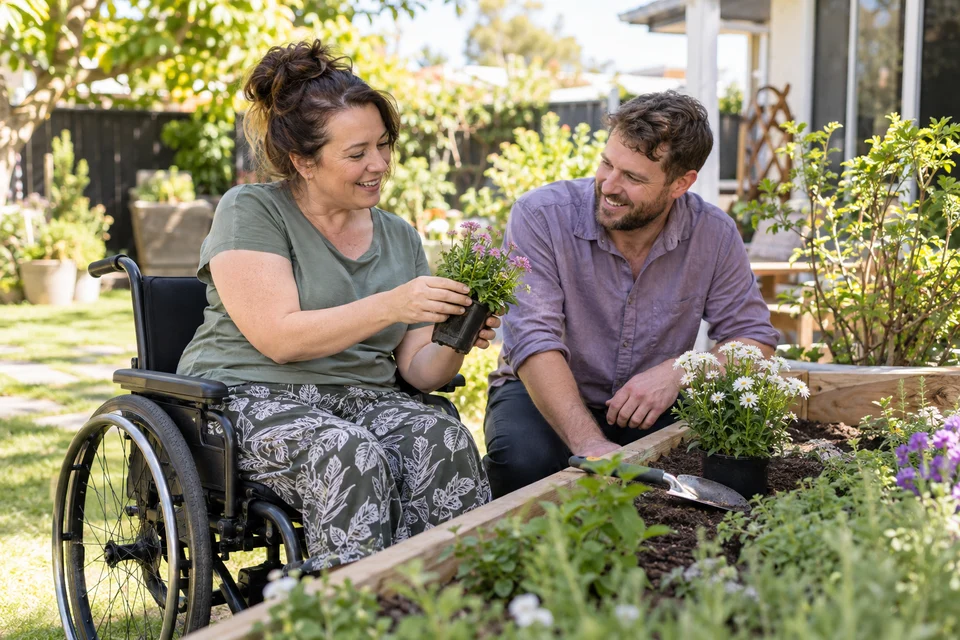
If you want to keep gardening yourself, a worker can help with the parts that are hard, like lifting pots or bags of soil. You stay involved in the garden you enjoy.
What to know before you start.
What is usually in scope, and what usually isn't
The NDIS list of supports includes house or yard maintenance as a household task. This means essential jobs you are not able to do yourself because of your disability. NDIS pricing describes it as performing essential house and yard activities that the participant is not able to undertake.
In practice, that usually means keeping your yard safe, usable and in order. Jobs like mowing, weeding, raking and clearing paths fit this description. Whether it's funded depends on your plan and what the NDIA agrees is reasonable and necessary.
The NDIA list of supports that are not NDIS supports includes:
- Standard home repairs, home improvements and standard renovations.
- Fencing, gates, building repairs and standard home security and maintenance costs.
- Pools, spas, pool heating and pool maintenance.
- Standard household and garden items, appliances, tools and products, such as a lawn mower.
- Costs of meeting a lease, such as pest control and general damage repairs.
Landscaping, garden projects and home changes
If a job would change or improve your garden, rather than keep it in order, check with the NDIA before you plan it. New landscaping is an example. The NDIA lists home improvements and standard renovations as not NDIS supports.
Some changes are a different support. NDIA guidance gives the example of a person who uses a wheelchair and needs a safe path from the carport to the front door. That path was treated as a home modification, which has its own assessment process.
How yard maintenance can be funded in your NDIS plan
Yard and garden help comes from your Core supports budget, in the category Core – Assistance with Daily Life. Providers claim it with the household task item for house or yard maintenance. The NDIA's Core supports page lists yard maintenance as one of the everyday tasks support workers can help with.
If a worker helps you build skills to look after your own home and yard, it may be claimed as assistance with personal domestic activities. NDIS pricing says that item applies when you own your home, or are fully or mostly responsible for keeping it up.
Adapted tools that help you garden yourself are a separate category, called assistive products for household tasks. The NDIA also considers what family, friends or the community could reasonably help with.
Starting home and garden support
Get in touch by phone on 1800 148 857, by email at admin@heartforcare.com.au, or with the online form. Tell us about your yard: its size, any slopes or steps, and which jobs you need help with.
You complete an intake form and sign a written service agreement before work starts. We do a risk assessment and write a support plan that lists the jobs and how often they happen. We match a worker to your needs and preferences, and review the plan regularly and when things change. You can give feedback or complain to us or to the NDIS Quality and Safeguards Commission.
Information checked against official NDIS sources in October 2026. Your plan and the NDIS rules decide what can be funded.
Getting started with this support.
- 01
Tell us what you need
Share your goals, location and the support you’re looking for.
- 02
Talk through the options
Discuss suitable support, funding and availability with our team.
- 03
Choose how to proceed
Decide on your next step with the information you need.
Before support starts, ask about availability, costs and your agreement. What to check
Questions people ask.
Have another question? Ask our team.
/01Does the NDIS pay for lawn mowing?
Mowing can be part of house or yard maintenance if your disability stops you doing it yourself. It needs to be in line with your plan, and the NDIA must agree it is reasonable and necessary. The cost of buying a mower is not included.
/02Can NDIS funding pay for landscaping or new garden beds?
Usually not as yard maintenance. Home improvements and standard renovations are on the NDIA list of supports that are not NDIS supports. If you need changes to get in and out of your home safely, ask the NDIA about home modifications.
/03I rent my home. Can I still get help with the yard?
Check your lease first to see who is responsible for the yard. If the yard is yours to look after and your disability stops you doing essential jobs, yard help may be considered for your plan. Costs of meeting a lease, such as general damage repairs, are not NDIS supports.
/04Does the NDIS pay for pool cleaning?
No. Pools, spas, pool heating and pool maintenance are on the NDIA list of supports that are not NDIS supports.
/05How often can I get yard help?
It depends on your needs and your Core budget. Many yards need more work at some times of year, so we can plan visits around that with you.